

Ferret vaccination and desexing schedule: what to get, when, and why
Ferrets have a reputation for being "just like cats" because they are carnivores and they live in our homes, but their preventive medicine schedule is genuinely different. Two diseases kill pet ferrets more than any others — canine distemper and adrenal disease — and both are largely preventable with the right vaccination and desexing plan. The trouble is that the wrong vaccination schedule is nearly as dangerous as none, especially with the live canine distemper vaccines that some ferrets react badly to.
This is what I run on every ferret that comes through my practice.
The two core vaccines
1. Canine distemper (CDV)
The most important vaccine for any ferret. Canine distemper is essentially 100% fatal in ferrets, with most deaths occurring within 10–14 days of exposure. Ferrets catch it from contact with dogs, other ferrets (especially in pet shops or shelters), and on surfaces or clothing that has been in contact with infected animals.
Symptoms progress rapidly: fever, nasal and ocular discharge, thickened footpads ("hard pad"), neurological signs, death.
Two vaccine options exist:
| Vaccine | Type | Use in ferrets |
|---|---|---|
| Nobivac Puppy DPv (Merck) | Live attenuated (Onderstepoort strain) | Recommended — proven safe in ferrets, used worldwide |
| Purevax Ferret Distemper (Boehringer) | Recombinant canarypox vector | Excellent safety profile, no live distemper virus involved |
| Galaxy DA2PPv (Intervet) | Live attenuated | Used in some regions; not as well-validated in ferrets |
| Nobivac DH (Merck) | Live attenuated | AVOID — historically associated with post-vaccinal disease in ferrets |
The key rule: only use ferret-validated vaccines. Some live CDV vaccines that are safe in dogs cause disease in ferrets because the ferret immune system handles them differently. Nobivac Puppy DPv and Purevax Ferret Distemper are the two I trust.
Schedule:
| Age | Vaccine |
|---|---|
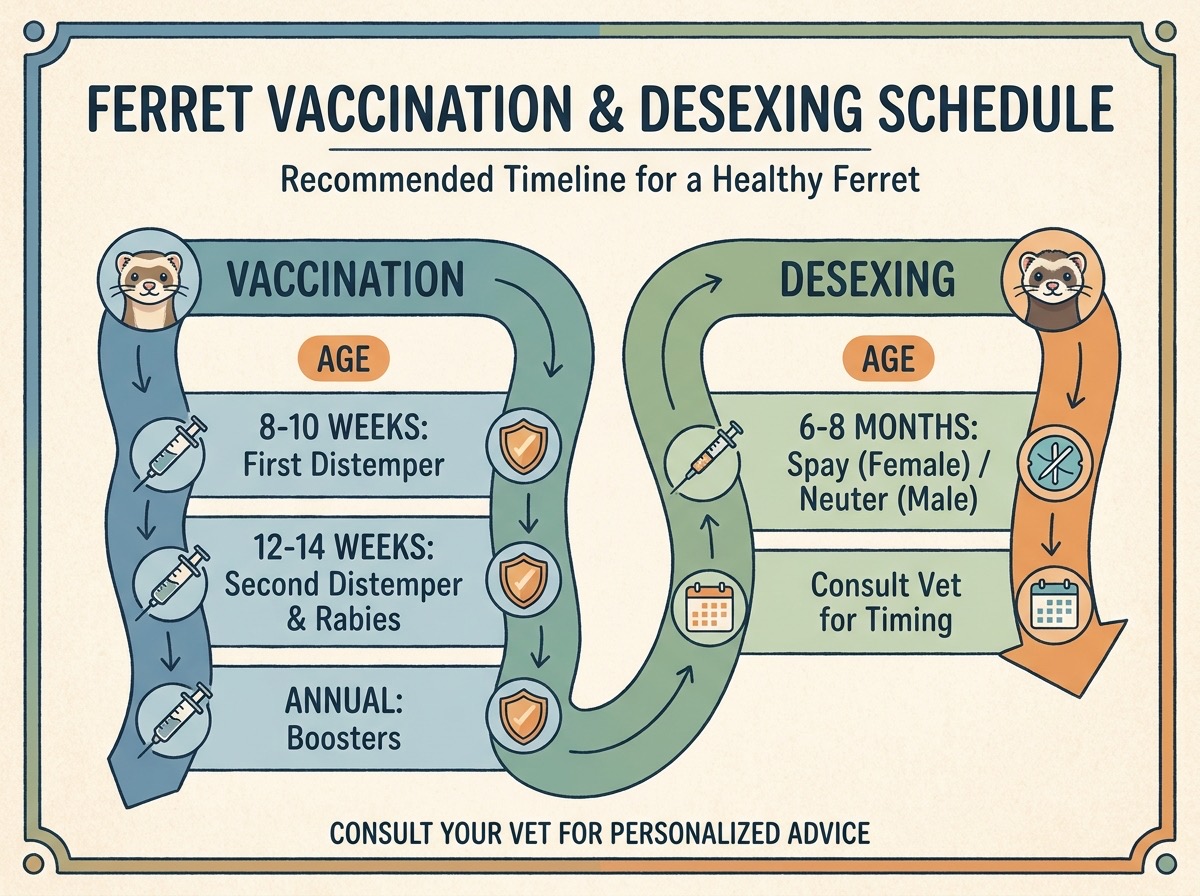
| 6–8 weeks | First Nobivac Puppy DPv |
| 10–12 weeks | Second Nobivac Puppy DPv |
| 14–16 weeks | Third Nobivac Puppy DPv |
| Annual | Booster Nobivac Puppy DPv |
For Purevax Ferret Distemper (recombinant, no adjuvant):
| Age | Vaccine |
|---|---|
| 8 weeks | First |
| 11 weeks | Second |
| 14 weeks | Third |
| Annual | Booster |
If a ferret is adopted as an adult with unknown vaccination history, give two boosters 3–4 weeks apart and then annual.
2. Rabies
Required by law in most jurisdictions for ferrets. The killed rabies vaccines are the standard:
- Imrab 3 (Merck) — killed, used in ferrets, 1-year or 3-year duration
- Purevax Rabies (Boehringer) — recombinant canarypox vector, 1-year, sometimes 3-year in cats (off-label in ferrets)
Schedule:
| Age | Vaccine |
|---|---|
| 12–14 weeks | First rabies (killed) |
| Annual or triennial | Booster, per local law and product label |
Ferrets with suspected rabies exposure and no vaccination history are typically subject to 6-month quarantine or euthanasia, depending on jurisdiction. Keep vaccination current.
Diseases where vaccination is NOT routinely recommended
A few ferret owners ask about vaccines for other diseases. The current evidence:
- Aleutian disease (parvovirus of mink/ferrets) — no vaccine available. Prevention is by testing and isolation of positive animals.
- Canine hepatitis (adenovirus) — not a meaningful disease in ferrets. No vaccine use.
- Leptospirosis — not a meaningful disease in pet ferrets. No vaccine use.
- Feline panleukopenia — ferrets are not susceptible to this virus.
Don't pay for vaccines that don't apply. Spend the money on the two that do (CDV + rabies) and on the other preventive that ferrets actually need more than vaccines.
Des-exing: when and why
Ferrets in the US, UK, and Australia are typically sold already desexed (jills spayed, hobbles castrated) by the breeder or at the shelter. If you have an intact ferret, desexing is recommended:
- Jills (females) — must be desexed unless bred. Jills stay in heat continuously until mated or desexed. Prolonged oestrus causes severe oestrogen-induced bone marrow suppression, which is often fatal. If you acquire an intact jill, desex at the earliest opportunity.
- Hobbles (males) — desexing reduces musky scent, urine marking, and aggression toward other males. It does not affect personality significantly.
Recommended timing:
| Sex | Age for desexing |
|---|---|
| Jill | 4–6 months (or as soon as acquired if older) |
| Hobble | 4–6 months (or as soon as acquired if older) |
Some ferrets are desexed chemically with a Suprelorin (deslorelin) implant, which lasts 1–3 years. This is a useful alternative to surgical desexing for ferrets that are poor surgical candidates, or for ferrets that may be bred later.
The vaccine reactions to watch for
Ferrets can have anaphylactic reactions to vaccines, particularly to Nobivac Puppy DPv. The risk is small (estimated 1 in 10,000–50,000 doses) but real. The reactions occur within 5–30 minutes of injection.
What to watch for:
- Vomiting, diarrhoea
- Facial swelling, especially around the eyes and lips
- Difficulty breathing, wheezing
- Collapse, pale gums
- Severe lethargy
Always wait at the vet clinic for 30 minutes after a ferret vaccine. If a reaction occurs, the vet can administer epinephrine and antihistamines immediately. Some practices also pre-treat with diphenhydramine (Benadryl) 15 minutes before the vaccine for ferrets with a known vaccine reaction history.
What about adrenal disease?
Adrenal disease is one of the most common medical conditions in middle-aged to older ferrets (3+ years), with incidence in some studies as high as 50–70% in desexed ferrets over 5. It is not prevented by desexing (and may actually be slightly more common in early-desexed ferrets in some studies), but the symptoms are manageable.
Deslorelin (Suprelorin) implants are the most effective treatment I have used. A 4.7 mg implant placed subcutaneously between the shoulder blades lasts 1–3 years depending on the ferret's metabolism. The implant is repeated when symptoms return.
Symptoms to watch for:
- Symmetrical hair loss starting at the base of the tail
- Vulval enlargement in spayed jills
- Pruritus (itching)
- Aggression in previously gentle ferrets
- Increased musky scent
Discuss with your vet whether a deslorelin implant is appropriate for your ferret at age 3.
Other preventive care
While on the topic of preventive medicine, here is the rest of what ferrets need:
| Item | Frequency |
|---|---|
| Annual vet check | Every year for ferrets under 4, every 6 months for ferrets 4+ |
| Bloodwork (CBC, chemistry) | Annually from age 3 |
| Insulinoma screening (fasting blood glucose) | Annually from age 3 |
| Dental check | Annually |
| Cardiac auscultation | Annually |
| Parasite prevention | As needed; ferrets are susceptible to heartworm in endemic areas |
The bottom line
Ferrets need two core vaccines (canine distemper and rabies) and surgical desexing (or a deslorelin implant). The right CDV vaccine is critical — Nobivac Puppy DPv or Purevax Ferret Distemper are the two I trust; Nobivac DH should be avoided. Always wait 30 minutes at the vet after vaccination. The combination of correct vaccination, timely desexing, and early screening for adrenal disease and insulinoma is what gets ferrets to 8–10 years of healthy life.
---
About the author: [Ravi Patel](../Ravi%20Patel.md) is an MSc in Exotic Animal Medicine from Edinburgh with 18 years of practice, and a founding member of the Wildlife and Exotic Animal Veterinary Association (India).