

Bearded dragon black beard: stress signal, health warning, or perfectly normal?
A central bearded dragon (Pogona vitticeps) that was creamy yellow at breakfast and is jet black from chin to chest by mid-morning is showing one of the species' most distinctive signals. The same display that deters a rival male in the Australian outback is also the first outward sign of a gut impaction, a burn starting to ulcerate, or a vacuum cleaner. The colour change is the same; the cause is not. Sorting the five causes from each other takes about 60 seconds if you know what to look for.
What the black beard actually is
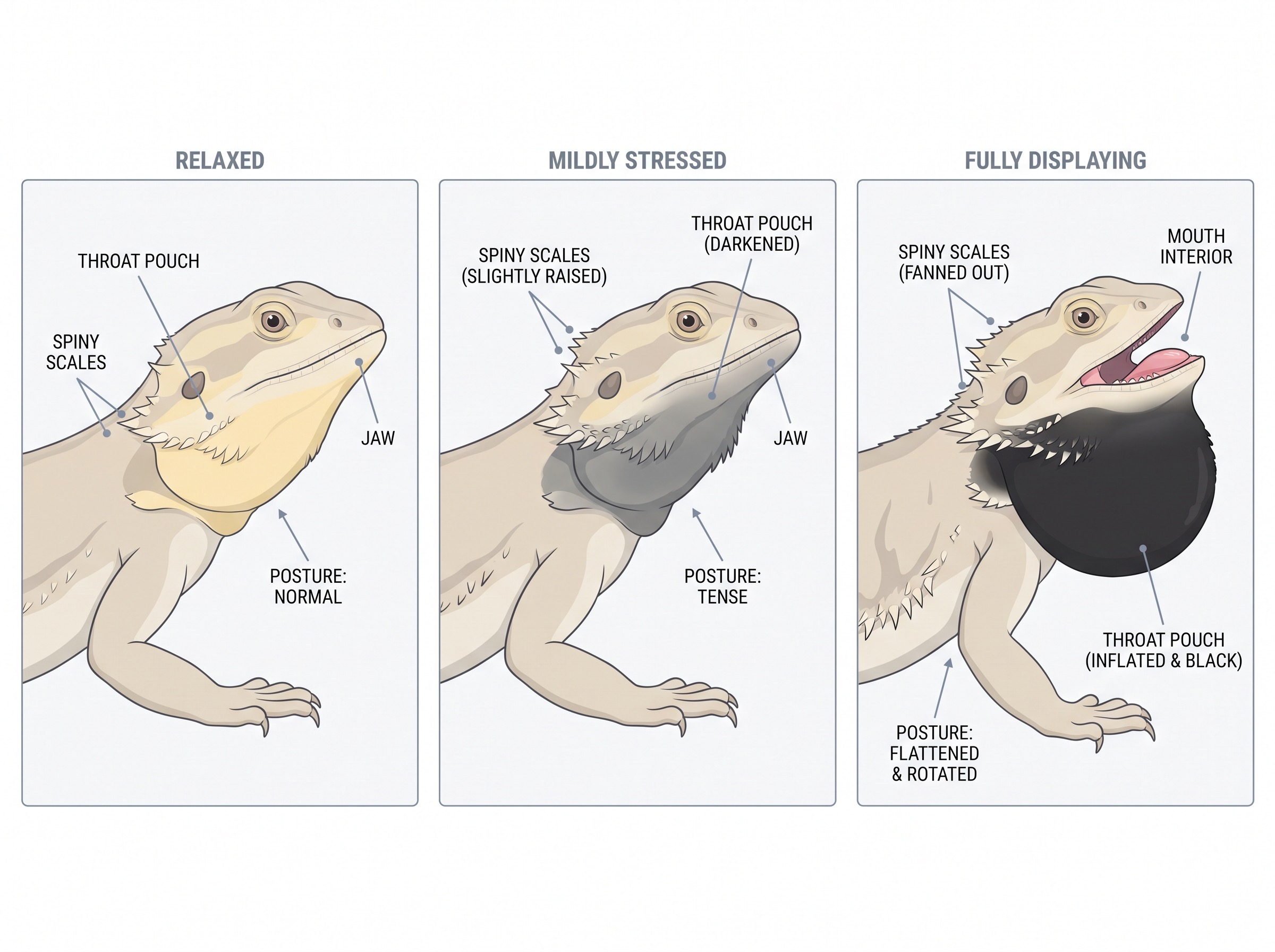
The "beard" is the loose, expandable throat pouch under the jaw, studded with spiny scales. Underneath is a dense layer of melanophores — pigment cells loaded with melanin. When the sympathetic nervous system fires (threat, pain, excitement), the melanophores dilate and the beard darkens within seconds, going from pale cream to charcoal to pure black. The same animal, relaxed on a warm rock an hour later, can be back to butter yellow.
Three things happen in parallel when the beard goes black:
- The pouch inflates. The dragon lifts the chin, fans out the spiny scales, and the beard looks twice its normal size — a size-increasing display, the lizard equivalent of a cat arching its back.
- The body flattens. The dragon presses itself broadside and rotates to present the maximum silhouette. Flattening and rotating = territorial or threat posture, not sick posture.
- The mouth opens. A wide-open, gummy black mouth is the final warning. The animal is two seconds from a lunge. Back off.
A dragon that shows only the colour change — black beard, but no inflation, no flattening, no open mouth — is signalling something subtler: mild startle, mild stress, or pain. The intensity of the posture tells you how urgent the message is.
The five causes, ranked by how often I see them
Across roughly 600 bearded dragon consultations a year, the breakdown runs in this order:
- Reflection in the glass (32%). A dragon sees its own reflection in a glass enclosure wall, a mirror nearby, a stainless steel feeding bowl, or a TV screen in a darkened room. It treats the reflection as a rival and displays for hours. Fix: anti-reflection film on the glass, matte ceramic bowls, the enclosure off-centre from any TV or window.
- Another dragon in sight or scent (24%). Even dragons housed together for years will black-beard through a glass divider. Two males cannot be cohabited. A male and a female can be cohabited only during a supervised breeding window. Two females are sometimes cohabited in a 180 × 60 × 60 cm (6 × 2 × 2 ft) enclosure, but the five-year failure rate is above 60%.
- Basking temperature wrong (18%). A basking spot too cool (below 38 °C at shoulder height) or too hot (above 45 °C) triggers a stress display. A cold dragon blacks the beard, holds the mouth open, glass-surfs. A hot dragon opens the mouth wide (gapes), blacks the beard, presses against the cool end. Both look similar; the thermometer reading separates them.
- New environment, new handler, or sudden change (14%). A dragon moved to a new enclosure, taken to a vet, or introduced to a new person will often black-beard for 24–72 hours and settle. If it has not resolved in a week, the cause is not novelty.
- Pain or early illness (12%). Impaction, a thermal burn starting to slough, mouth rot, a respiratory infection, or egg-binding in a female will all show a black beard as an early sign. This is the 12% that brings a dragon to a vet.
Reading the body language: the 60-second check
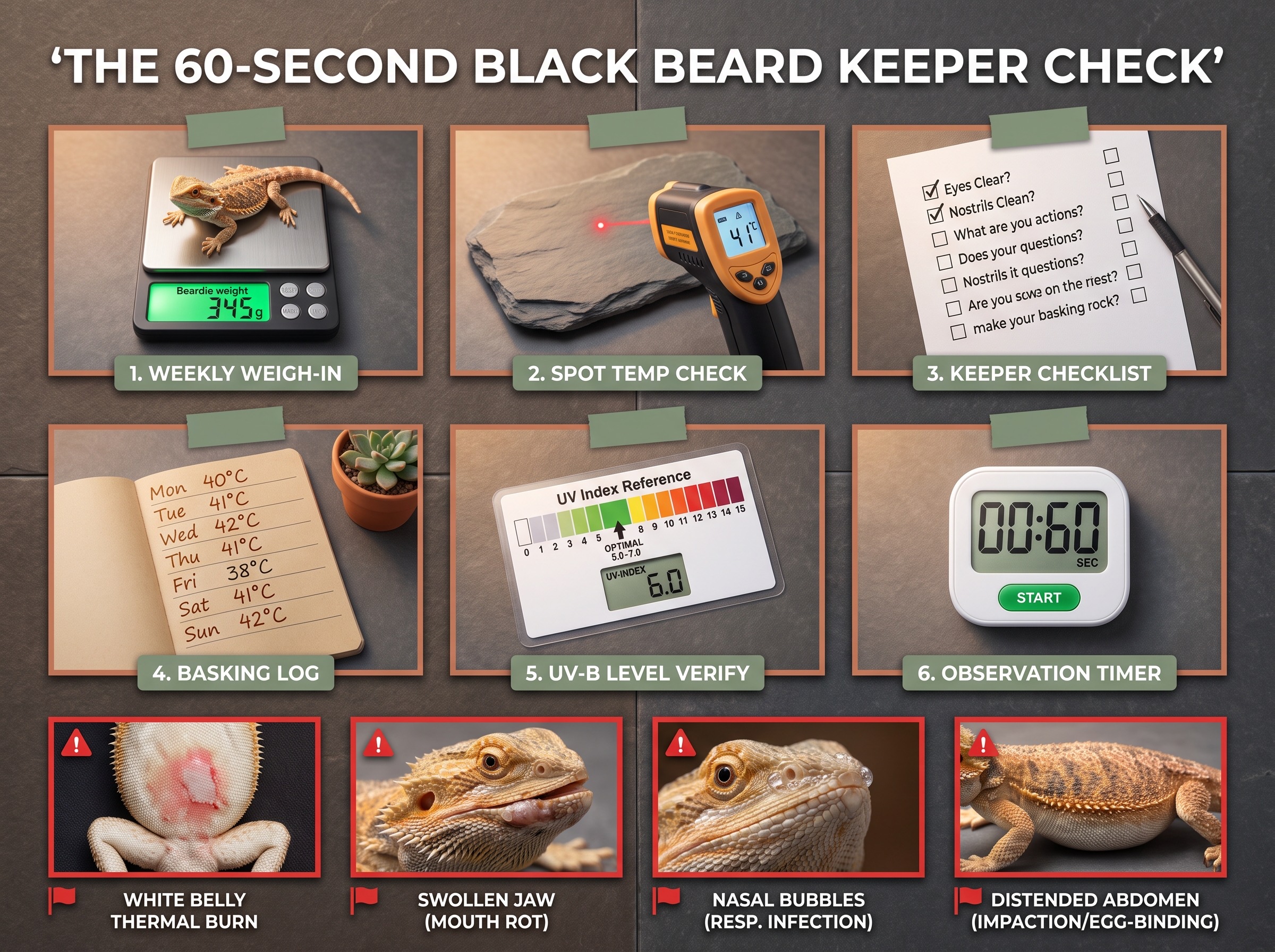
When a keeper calls me about a black beard, I run the same checklist on the phone. Six questions, 60 seconds:
- Is the dragon also inflating and rotating, or just darkening? Inflation plus rotation = territorial or threat display. Colour change only = stress, pain, or mild startle.
- Is the dragon eating and basking normally? A black-bearded dragon that still eats, basks 4–6 hours a day, and produces normal faeces is usually fine. Off food for more than 5 days with a black beard needs a vet.
- What is the basking temperature at shoulder height? Below 38 °C = too cold. Above 45 °C = too hot. Sweet spot 40–42 °C for an adult, measured with an infrared thermometer.
- Are there any visible signs on the body? Burn marks, a swollen lower jaw, bubbles from the nose, a lump in the abdomen, or a cloacal prolapse are all vet-now signs.
- When did the black beard start, and what changed the day before? A new decoration, a new bulb, a move to a new room, a new pet, a house guest, a thunderstorm — the day before is almost always different from the day before that.
- Is there another dragon anywhere in the room? Even in a different enclosure, out of direct line of sight. Dragons smell conspecifics through ventilation and display at the wall they think the rival is behind.
A "no" to questions 2 and 4 with a "yes" to question 1 usually means a behavioural trigger that can be fixed in a week. A "yes" to question 2 or any "yes" to question 4 means a same-day vet visit.
Health causes that mimic a stress display
Four health conditions present as a black beard more than any others, in this order:
- Impaction. A gut blockage, usually from loose substrate (sand, walnut shell, bark chips), an oversized insect, or a foreign object. The dragon goes off food, the beard darkens, the abdomen feels firm, the back legs may drag. Treatment: a warm 30 °C soak for 20 minutes, a drop of olive oil on the snout, a same-day vet visit. Prevention: solid substrate (slate tile, non-adhesive lino) and feeder insects no wider than the space between the dragon's eyes.
- Thermal burns. A basking bulb too close, or a rock directly under a halogen, will burn the belly and feet. The burn is white or pink on day one, then darkens. If the dark patch is localised to one part of the body rather than the throat pouch, suspect a burn. Prevention: bulb at the manufacturer's minimum height, a Habistat or Inkbird thermostat, and a flat rock no closer than 20 cm to the bulb.
- Mouth rot (infectious stomatitis). A bacterial infection of the gum line, usually secondary to a small injury or a vitamin A deficiency. Gums look cheese-like, saliva is thick, the mouth smells, the beard darkens. Vet treatment is essential — mouth rot can progress to osteomyelitis of the jaw.
- Egg-binding (dystocia) in females. A female carrying eggs she cannot lay goes off food, darkens in the beard and limbs, becomes lethargic within 7–10 days. Life-threatening emergency. A female over 18 months old that has been with a male and shows a black beard with a swollen abdomen is a same-day vet visit.
A bearded dragon that black-beards once a day for 30 seconds during a feeding is displaying, not sick. A bearded dragon that is black-bearded for 8 hours a day for a week is sick, in pain, or chronically stressed — and a vet is the next call.
Husbandry fixes that resolve 80% of chronic cases
Once pain and illness have been ruled out, chronic black-beard cases resolve with five husbandry changes, cheapest first:
- Basking temperature correction. Basking spot 40–42 °C for an adult, 42–44 °C for a juvenile, measured with an infrared thermometer at shoulder height. Cool end 24–26 °C. Night 18–21 °C. A reliable setup: an Arcadia 12% UVB T5 tube (or Zoo Med ReptiSun 10.0 T5) at 30–40 cm from the basking spot, paired with a 50–75 W halogen on a Habistat or Inkbird thermostat. Replace UVB tubes every 12 months.
- Enclosure size and layout. An adult needs a minimum 120 × 60 × 60 cm (4 × 2 × 2 ft) enclosure. The two most common chronic-stress causes I see are enclosures that are too small and enclosures with no visual cover. Add a hide at the warm and cool ends, a piece of cork bark, a few low branches. Background paper on three walls reduces reflections.
- Reflection control. Apply anti-reflection film to the front glass. Replace any metal bowls or decor with matte ceramic. A dragon that stops seeing its reflection often stops black-bearding within a week.
- Cohabitation review. A single dragon in a 120 × 60 × 60 cm enclosure is the standard. Two males cannot be cohabited. A male and a female only during a 4–6 day breeding window. Two females are possible in 180 × 60 × 60 cm but carry a 60% failure rate over five years.
- Routine and handling. Same feeding time, same lighting schedule, same handler, same room layout. A dragon that knows what is coming next is not stressed. Variable schedules and frequent redecoration are common chronic-stress triggers.
If the black beard persists after 4–6 weeks of these changes, the next step is a reptile vet visit with a faecal screen (coccidia and pinworms, common chronic-stress amplifiers) and a blood panel to rule out kidney disease and metabolic bone disease.

When to see a vet, and what to bring
A same-day vet visit is warranted for any of the following alongside a black beard: refusal of food for more than 5 days, weight loss of more than 10% in a month, a swollen abdomen, bubbles from the nose, an open-mouth posture at rest, a limp or dragging back leg, a visible burn, a prolapse, or any change in faecal consistency lasting more than a week. Bring the dragon in a dark, ventilated carrier at 24–26 °C with a heat pack wrapped in a towel. Bring a fresh faecal sample less than 4 hours old, a photo of the enclosure, and a 7-day log of basking temperatures — the log is often the most useful diagnostic a keeper can bring, because it tells the vet what the dragon has been living in for the last week, which is usually the last week the black beard has been present.
A dragon that black-beards once a day for 30 seconds during a feeding is displaying, not sick. A dragon black-bearded for 8 hours a day for a week is sick, in pain, or chronically stressed — the right call is a reptile vet, not another week of waiting. The colour change is a signal, not a diagnosis. Most of the time the answer is in the enclosure, not the dragon.