

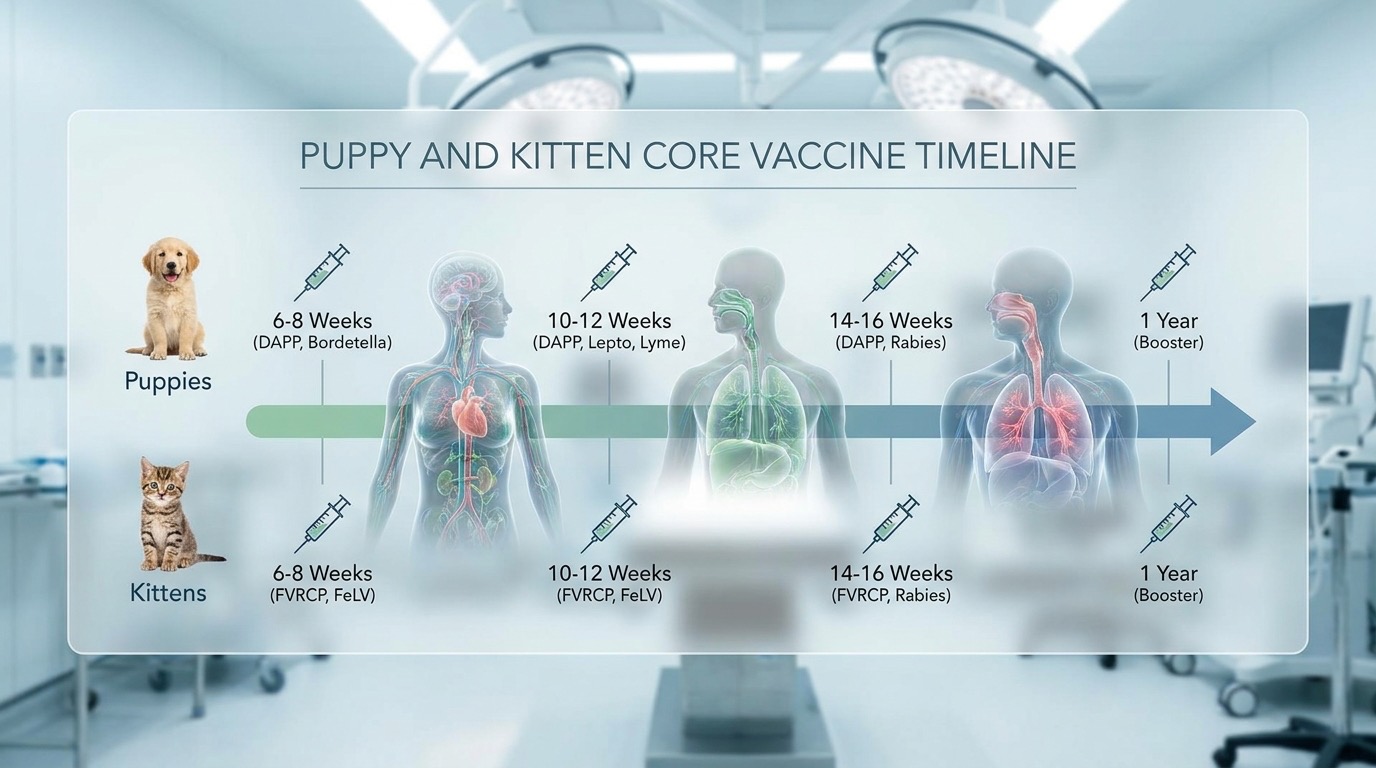
Puppy and kitten core vaccine timeline: what to give, when, and why
The core vaccine schedule for puppies and kittens is one of the most stable protocols in small animal medicine. The diseases it protects against — distemper, parvovirus, adenovirus, parainfluenza, rabies, panleukopenia, herpesvirus, calicivirus — have not changed in decades. What has changed is our understanding of maternal antibody interference, the minimum age at which a vaccine can be effective, and the appropriate interval between doses.
This is the schedule I run on puppies and kittens in my practice, with the rationale for each component.
The biology: why we give multiple doses
A puppy or kitten receives maternal antibodies through colostrum in the first 24 hours of life. These antibodies protect the neonate from disease but also block the vaccine from working — the immune system sees the vaccine antigen and thinks "antibodies are already there, no need to respond".
Maternal antibody levels decline at a variable rate:
- Some puppies lose maternal antibodies by 6–8 weeks
- Some retain them until 12–14 weeks
- A small percentage retain protective maternal antibodies until 16 weeks
Because we cannot predict when maternal antibodies will fall below the blocking threshold, we give a series of vaccinations starting at 6–8 weeks and continuing every 2–4 weeks until 16 weeks of age. The final dose is given when we are confident maternal antibodies no longer interfere.
This is the science behind the "last vaccine at 16 weeks or older" rule. A puppy that finishes the series at 12 weeks may still have residual maternal antibodies that blocked the vaccine from working — and is unprotected. The 16-week endpoint is what guarantees protection.
The canine core vaccine schedule
DA2PP (distemper + adenovirus + parainfluenza + parvovirus)
This is the single most important vaccine in canine medicine. All four diseases are serious and potentially fatal.
| Puppy age | Vaccine |
|---|---|
| 6–8 weeks | First DA2PP |
| 10–12 weeks | Second DA2PP |
| 14–16 weeks | Third DA2PP |
| 16–18 weeks | Fourth DA2PP (last dose) |
| 12 months | Booster |
| Every 3 years thereafter | Booster |
For puppies started at 6 weeks, four doses are needed to ensure one is given after maternal antibodies have waned. For puppies started at 9–10 weeks, three doses may suffice (vet's call based on risk and timing).
Modified live virus (MLV) vaccines are preferred over killed vaccines for DA2PP because they produce stronger, longer-lasting immunity and are less likely to cause vaccine reactions. Brands I use: Nobivac DHPPi, Vanguard Plus 5, Recombitek.
Rabies
Required by law in most jurisdictions. Timing:
| Puppy age | Vaccine |
|---|---|
| 12–16 weeks | First rabies (varies by jurisdiction and product) |
| 12 months | Booster |
| Every 1–3 years thereafter | Per local law and product label |
The age at which the first rabies vaccine can be legally given varies by country and US state. In the US, most states allow it at 12 weeks; some at 16 weeks. In the UK, rabies vaccination for pet travel is typically done at 12 weeks minimum.
The 1-year vs 3-year booster designation depends on the product used. A 3-year booster can only be given if the initial vaccines were properly administered with the same product.
Bordetella (kennel cough) — non-core but commonly needed
Bordetella bronchiseptica is the most common cause of canine infectious respiratory disease complex ("kennel cough"). The vaccine is non-core but recommended for any dog that:
- Goes to dog parks, daycare, or boarding
- Participates in training classes
- Is exposed to other dogs regularly
Schedule:
| Dog age | Vaccine |
|---|---|
| 8 weeks or older | First intranasal (preferred) or oral Bordetella |
| Annual | Booster |
The intranasal form provides faster immunity (within 48–72 hours) than the injectable form. The injectable form requires two doses 2–4 weeks apart for initial immunisation.
Rabies variants (other non-core)
Several non-core vaccines exist for dogs based on lifestyle and geography:
- Leptospirosis — recommended in most regions; outbreaks occur in urban and rural settings
- Canine influenza — recommended for dogs in outbreak areas or high-density exposure
- Lyme disease — recommended in endemic areas (northeastern US, upper midwest)
- Rattlesnake toxoid — recommended only for dogs in high-risk western US areas
Discuss with your vet which of these apply to your dog's lifestyle.
The feline core vaccine schedule
FVRCP (feline viral rhinotracheitis + calicivirus + panleukopenia)
The single most important vaccine in feline medicine. All three diseases are serious; panleukopenia (feline distemper) is often fatal.
| Kitten age | Vaccine |
|---|---|
| 6–8 weeks | First FVRCP |
| 10–12 weeks | Second FVRCP |
| 14–16 weeks | Third FVRCP (last dose) |
| 12 months | Booster |
| Every 3 years thereafter | Booster (for indoor cats) |
Modified live virus (MLV) vaccines are standard. Purevax (recombinant canarypox vector) is the only non-adjuvanted option for cats — important for cats at risk of injection-site sarcoma.
Rabies
Required by law for cats in most US jurisdictions (and increasingly in other countries). The 1-year vs 3-year product distinction is the same as for dogs.
For cats, Purevax Rabies (recombinant, no adjuvant) is strongly preferred over adjuvanted rabies vaccines because of the long-term sarcoma risk from adjuvant injection-site reactions. Discuss with your vet.
FeLV (feline leukemia) — non-core but commonly needed
FeLV is a retrovirus that causes immunosuppression, anaemia, and lymphoma. Outdoor cats and multi-cat households should be vaccinated; indoor-only single-cat households may not need it.
For kittens, the protocol has shifted: the AAFP now recommends FeLV vaccination for all kittens under 1 year, regardless of lifestyle, then reassessing at the 1-year booster.
| Kitten age | Vaccine |
|---|---|
| 8 weeks | First FeLV (recombinant) |
| 12 weeks | Second FeLV |
| 12 months | Booster |
| Annual or every 3 years | Based on lifestyle reassessment |
FIV (feline immunodeficiency virus) — non-core
FIV vaccination is rarely recommended. The vaccine interferes with FIV testing (vaccinated cats test positive on standard tests), and the disease is manageable in most cats. Discuss with your vet if your cat is at very high risk.
What the vaccine reactions look like
Most puppies and kittens experience no vaccine reactions. When they do occur, the spectrum:
Mild (1–2 days)
- Soreness at injection site
- Low-grade fever
- Decreased appetite for 12–24 hours
- Mild lethargy
These are normal immune responses and self-resolve. Treat with rest and observation.
Moderate
- Facial swelling, especially around the eyes and muzzle
- Hives
- Vomiting (single episode, not persistent)
Call your vet. Treatment typically involves diphenhydramine (Benadryl) and a corticosteroid injection. Future vaccines may be pre-treated or alternative products used.
Severe (anaphylactic)
- Difficulty breathing
- Collapse
- Pale gums
- Severe vomiting
This is an emergency. Go to the nearest emergency vet immediately. Treatment includes epinephrine, IV fluids, and supportive care. Subsequent vaccines need to be managed carefully (pre-treatment, alternative products, split dosing).
What I tell every puppy and kitten owner
The seven most common questions, with the answers I give:
"Why so many doses?" Maternal antibody interference. The series is needed to ensure at least one dose is given after maternal antibodies have waned.
"Can I skip the 16-week dose if my puppy seems healthy?" No. The 16-week dose is the one most likely to actually immunise. Skipping it leaves the puppy vulnerable.
"My puppy was vaccinated at 6 weeks by the breeder. Does he need to restart?" Yes. He needs the full series ending at 16 weeks. The breeder vaccine was given too early to be effective.
"Can I space the doses further apart?" Yes, slightly. Going 4 weeks apart is fine. Going 6+ weeks apart is not recommended — there's a small risk of a "window of susceptibility" between when maternal antibodies wane and the next dose takes effect.
"Are vaccine titers an alternative?" Partially. A titer test confirms immunity if positive, but a negative titer doesn't distinguish between "needs another dose" and "just received the dose and hasn't responded yet". The current recommendation is to vaccinate according to the schedule and use titers to determine the need for boosters in adult dogs.
"What about annual boosters vs every 3 years?" Current AAHA and WSAVA guidelines support every-3-year boosters for the core vaccines in adult dogs and cats. Annual vaccination is no longer considered best practice.
"Should I vaccinate my indoor-only cat?" Yes, for the core vaccines. Panleukopenia and the respiratory viruses can be brought into the home on shoes, clothing, or new pets. Indoor cats need the core vaccines.
The bottom line
The puppy and kitten vaccine schedule is one of the highest-leverage investments you can make in your pet's long-term health. The schedule is well-established, the diseases it protects against are serious, and the reaction rate is low. Follow the schedule, finish the series at 16 weeks or older, and reassess at the 1-year booster to determine the ongoing interval (typically every 3 years for core vaccines). Your vet will help you decide on the non-core vaccines based on your pet's lifestyle and your region's risk profile.
---
About the author: [Dr. James Morrison](../James%20Morrison.md), DVM, is a Cornell-trained veterinarian and founder of Bayview Animal Hospital in San Francisco, with 26 years of clinical practice.