

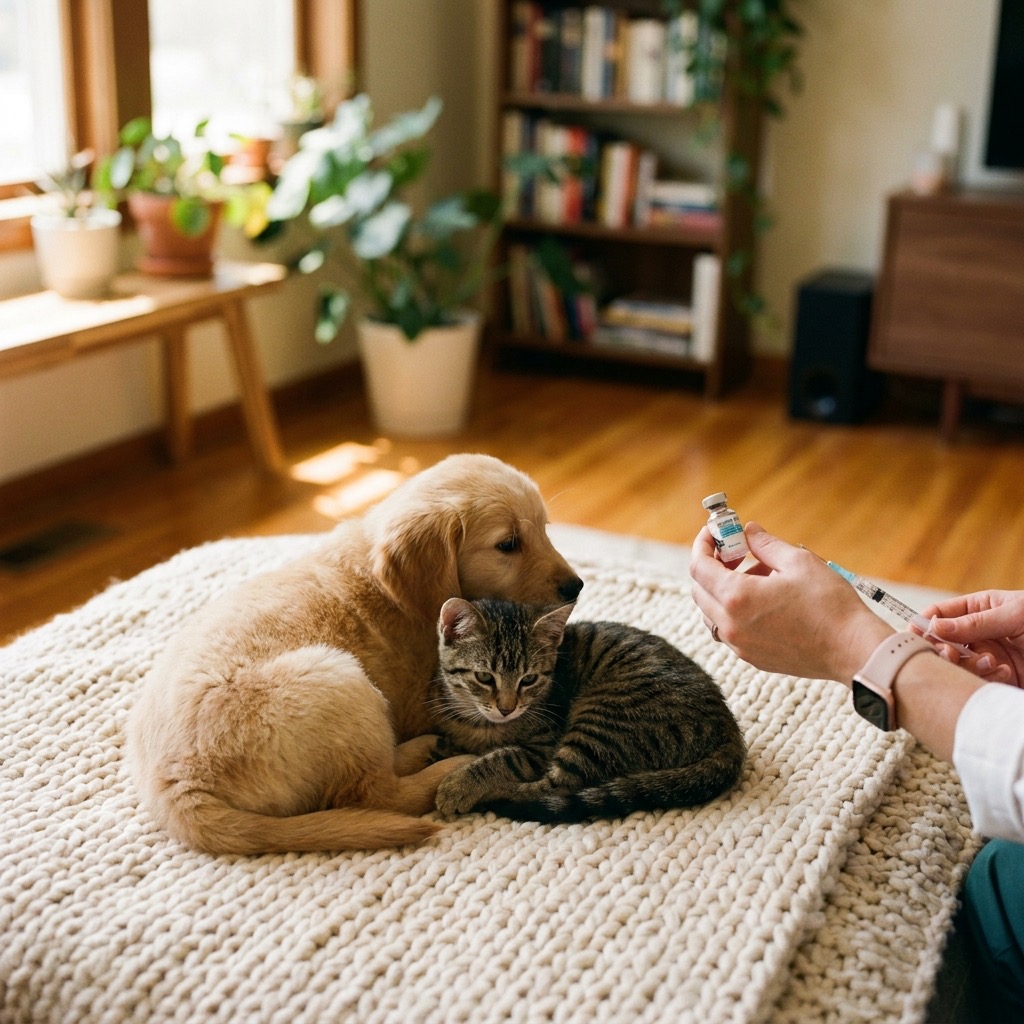
Puppy and kitten core vaccine timeline: what to give, when, and what to skip
The single most common mistake new owners make is bringing home an 8-week-old puppy, getting one vaccine, and assuming the protection is done. It is not. The puppy and kitten vaccine timeline exists for one biological reason — maternal antibodies — and the timing is not negotiable. Here is what the schedule looks like in 2026, what is actually being injected, and how to decide when to deviate.

Why the schedule starts at 6–8 weeks and ends at 16 weeks
Newborn puppies and kittens absorb antibodies from their mother's colostrum in the first 24 hours of life. These maternal antibodies (MDA) protect the neonate while its own immune system boots up, but they also neutralize vaccines. A vaccine given while MDA is high produces little to no immunity in the puppy — the antibodies simply bind the vaccine antigens and clear them.
MDA levels fall at a predictable rate:
- By 6 weeks: ~40% of puppies still have blocking MDA
- By 10 weeks: ~20% still have blocking MDA
- By 14 weeks: ~5% still have blocking MDA
- By 16–18 weeks: <1% — the "window of susceptibility" has closed
Because we cannot test every individual puppy's MDA level cheaply, we series-vaccinate — give the same dose at 3–4 week intervals from 6–8 weeks through at least 16 weeks. The first dose that lands after MDA drops is the one that takes. Earlier doses are not wasted; they prime the system.
The core vaccines for puppies: DA2PP and rabies
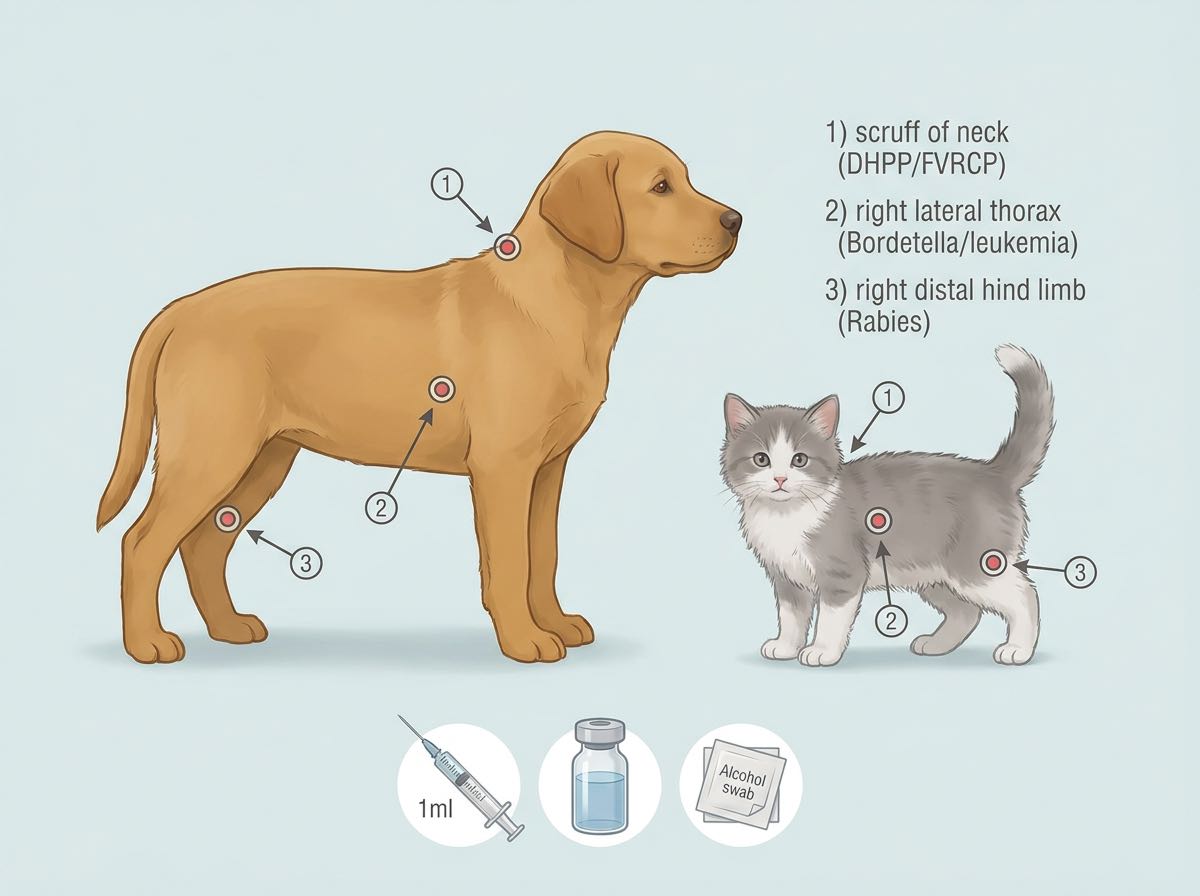
DA2PP (also written DHPP) covers four pathogens and is given as a single subcutaneous injection:
- D — Canine Distemper Virus (CDV)
- A2 — Canine Adenovirus Type 2 (cross-protects against infectious hepatitis / CAV-1)
- P — Canine Parvovirus Type 2 (CPV-2)
- P — Canine Parainfluenza Virus (CPiV)
Most U.S. products are modified-live (MLV). A few are killed; MLV produces faster, stronger immunity but should not be used in pregnant dogs or dogs on high-dose immunosuppressants.
Standard DA2PP schedule:
| Dose | Age | Notes |
|------|-----|-------|
| 1 | 6–8 weeks | Earliest safe start |
| 2 | 10–12 weeks | 3–4 weeks after dose 1 |
| 3 | 14–16 weeks | Critical dose — first one likely to take |
| 4 (optional) | 18–20 weeks | Used by some clinics to close the gap |
| Booster | 12 months after dose 3 | Then every 1–3 years per label |
Rabies is given once at 12–16 weeks (state law sets the minimum age — many states require 12 weeks, some 16). It is always a killed vaccine. The first dose is valid for 1 year; subsequent doses are valid for 3 years in most U.S. states with a labeled 3-year product.
Brand names in common use (U.S., 2026): Nobivac DA2PP, Vanguard Plus 5, Recombitek, and Zoetis' Versican Plus. All are 1 mL subcutaneous.
The core vaccines for kittens: FVRCP and rabies
FVRCP is the feline equivalent and covers three pathogens:
- FVR — Feline Viral Rhinotracheitis (FHV-1, feline herpesvirus)
- C — Feline Calicivirus
- P — Feline Panleukopenia (FPV, "feline parvo")
FVRCP is given as a single subcutaneous injection, almost always modified-live. The killed version exists for pregnant queens and immunocompromised cats only.
Standard FVRCP schedule:
| Dose | Age | Notes |
|------|-----|-------|
| 1 | 6–8 weeks | |
| 2 | 10–12 weeks | |
| 3 | 14–16 weeks | Critical dose |
| Booster | 12 months after dose 3 | Then every 1–3 years |
Rabies for kittens follows the same timing as puppies: a single dose at 12–16 weeks, 1-year label, then 3-year.
PureVax (Merck) is the preferred feline rabies vaccine in many clinics because it is a recombinant canarypox-vector product — non-adjuvanted, with a markedly lower risk of injection-site sarcoma (FISS). It is more expensive but worth it for cats.
When to delay a vaccine (triage at the front desk)
A sick animal should not be vaccinated. Vaccine-induced immunity in a sick patient is poor, and the vaccine can deepen existing illness. Defer if the puppy or kitten presents with any of the following:
- Rectal temperature ≥ 39.7 °C (103.5 °F)
- Active vomiting or diarrhea
- Anorexia for more than 24 hours
- Known exposure to parvovirus or panleukopenia in the past 7 days
- Currently on systemic corticosteroids (prednisone ≥ 1 mg/kg/day for >2 weeks)
- Recent (within 2 weeks) elective surgery
Do not defer for: mild nasal discharge in a kitten still eating well, mild post-adoption stress, low-grade intestinal parasites being dewormed, or a recent routine neuter. These are not contraindications.
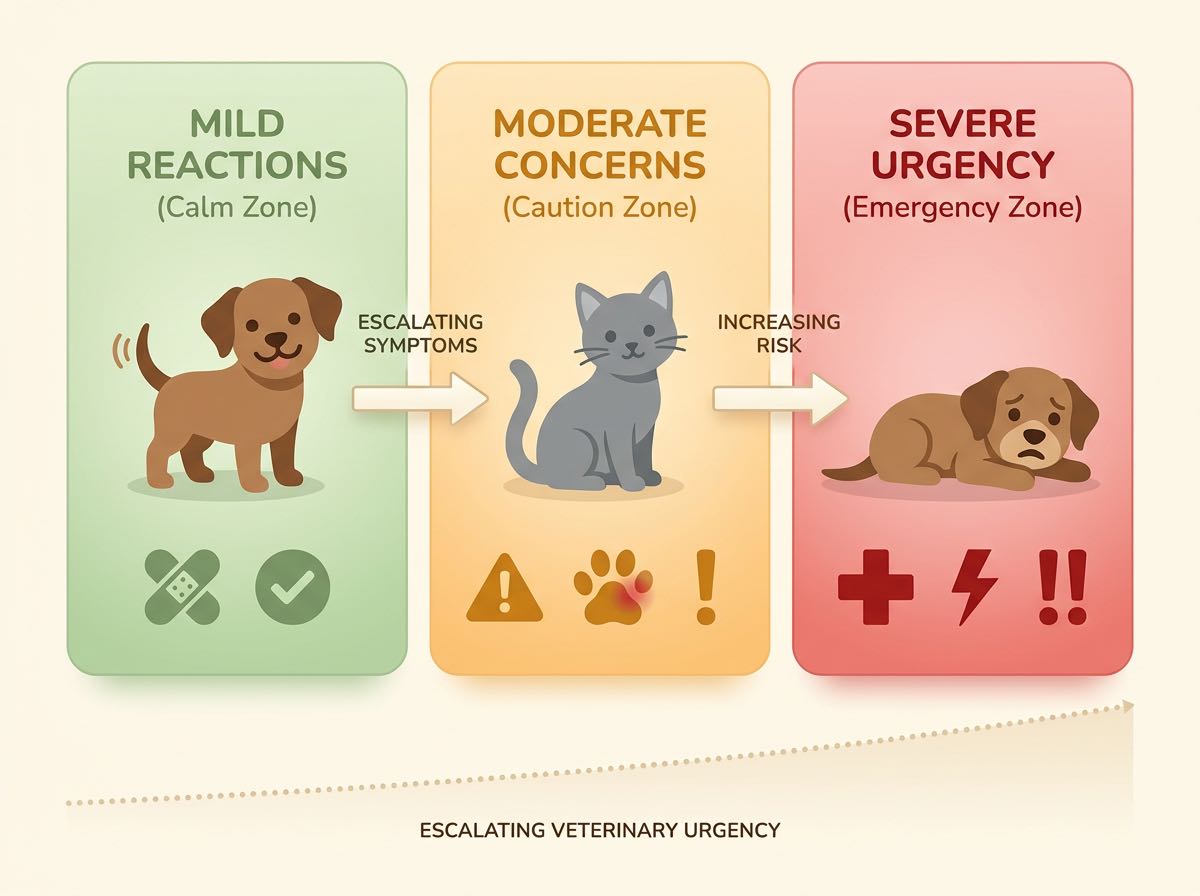
When to escalate: vaccine reactions are emergencies
Adverse reactions are uncommon (roughly 1 in 250–1,000 vaccinations) but when they happen, they happen fast. Most occur within 30 minutes of injection — which is why clinics ask you to wait in the lobby.
Mild (treat at home, call the clinic):
- Localized swelling or soreness at the injection site lasting 24–48 hours
- Mild lethargy or reduced appetite for one meal
- Low-grade fever (< 39.5 °C / 103 °F)
Moderate (call the clinic now, often same-day visit):
- Facial swelling (periorbital, muzzle)
- Hives or generalized urticaria
- Vomiting 2+ times
Severe (go to the ER vet immediately):
- Collapse or weakness
- Pale gums
- Difficulty breathing
- Repeated vomiting or bloody diarrhea
- Seizure
Anaphylaxis is rare but carries a 1–2 hour window where epinephrine reverses it. After that, it can be fatal. If you see facial swelling, collapse, or breathing changes, you are at the emergency clinic, not waiting for your regular vet to open.
Non-core vaccines: only what the lifestyle demands
Core vaccines protect against ubiquitous, severe disease. Non-core vaccines protect against pathogens that depend on exposure. Skip them unless the lifestyle matches.
- Leptospirosis — dogs with access to standing water, wildlife urine, or rural environments. Two-dose initial series, then annual. Killed vaccine; risk of post-vaccinal reaction in toy breeds under 5 kg is higher.
- Bordetella bronchiseptica — dogs in boarding, daycare, dog parks, or grooming. Single intranasal dose or two-dose oral/parenteral series. Annual or 6-monthly depending on risk.
- Canine influenza (H3N2 / H3N8) — similar risk profile to Bordetella. Two-dose initial series.
- Feline leukemia (FeLV) — outdoor cats or households adding a new cat of unknown status. Two-dose initial series as a kitten, then annual if still at risk; all positive cats should be vaccinated, full stop.
- FIV (feline immunodeficiency virus) — rarely recommended in the U.S.; interferes with future FIV/FeLV testing. Skip unless there is a specific high-risk reason your vet can justify.
Rattlesnake vaccine (Crotalus atrox toxoid) — only in rattlesnake-endemic regions and only for dogs with high exposure. Efficacy is debated; cost is real. Discuss with your local vet.
The exact follow-up schedule to write on your fridge
For a typical puppy or kitten in a low-risk household:
- 6–8 weeks: DA2PP or FVRCP dose 1
- 10–12 weeks: dose 2 + (optional lifestyle vaccines)
- 14–16 weeks: dose 3 + rabies
- ~12 months: first annual booster (DA2PP/FVRCP + rabies)
- Annually thereafter: lifestyle vaccines only; core boosters every 1–3 years per label
If you adopted a puppy or kitten of unknown vaccine history, do not restart the series — give one dose now, then complete the series at the standard intervals. Do not assume shelter vaccines "count" unless you have signed, dated records from a licensed veterinarian.
A vaccine card from the breeder or a Facebook post is not a record. If you are not sure, your vet will re-dose and move on. It is safer than skipping.
---
The schedule above reflects 2026 AAHA canine vaccination guidelines and AAFP feline vaccination guidelines. Local rabies laws vary by state and country — check with your veterinarian for the legal minimum in your jurisdiction. This article is informational and does not replace an in-person exam.