

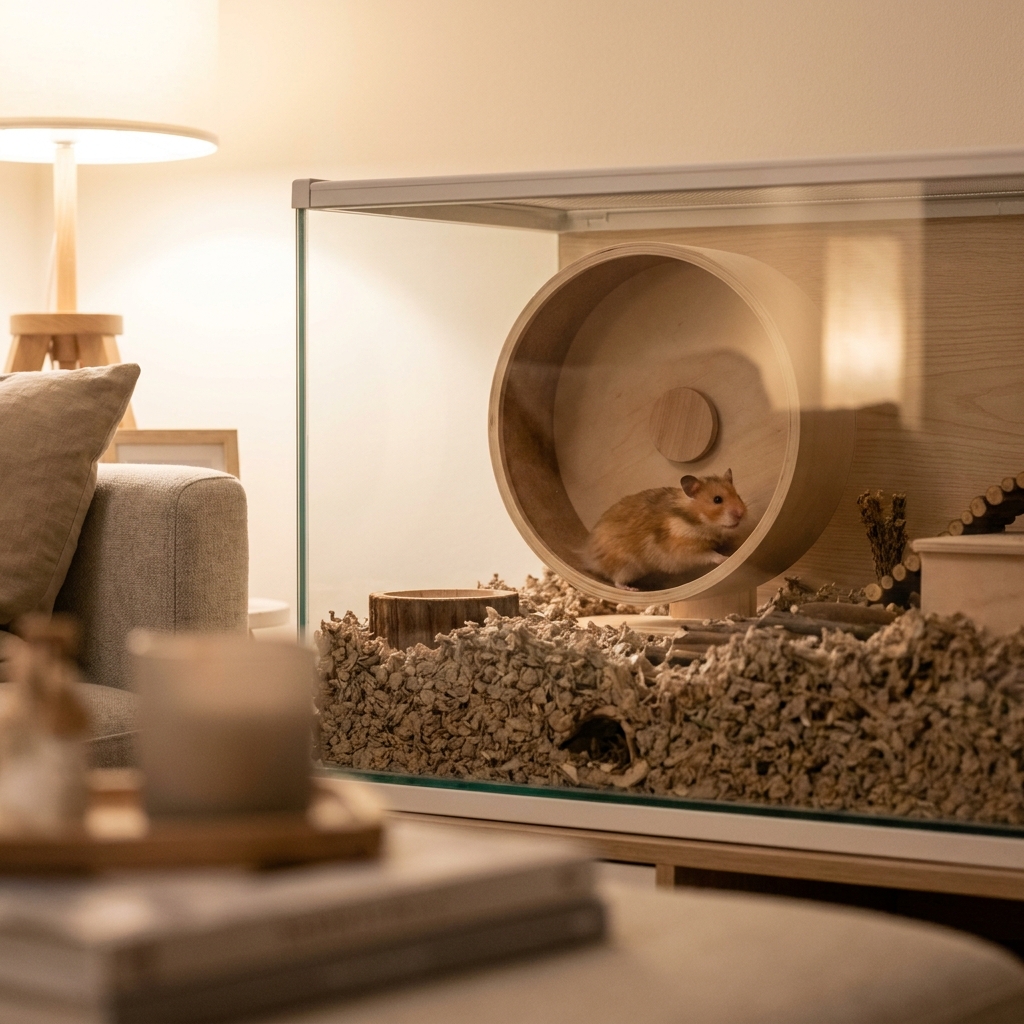
Hamster cage size and running wheel requirements
The first thing most new hamster owners do is buy what the pet shop sold them. The second thing most new hamster owners do is wonder why their hamster is climbing the bars, biting the plastic, sleeping all day, and acting aggressive. The two things are connected, and the connection is the cage.
A pet shop hamster starter kit typically includes a cage of about 50x30 cm with a 16 cm wheel and a few plastic tubes. This setup is, in modern small-animal husbandry terms, below the minimum. It will keep a hamster alive. It will not keep a hamster well. The animal will show stress behaviors - bar chewing, pacing, biting, sleep reversal - within weeks. I have had clients bring in "aggressive" hamsters that became docile and active once moved into an appropriately sized enclosure.
The minimum cage size
For Syrian hamsters (the larger, solitary species), the German TVT animal welfare standards and most modern husbandry guides recommend a minimum unbroken floor space of 100x50 cm, with a cage height of at least 50 cm to allow for deep bedding. Unbroken means one connected space - not a multi-level cage with tubes and platforms. Hamsters are not climbers by nature, they are burrowers, and the floor area is what matters.
For dwarf hamsters (Roborovski, Campbell, Winter White), the minimum is 80x50 cm of unbroken floor space. The smaller body does not proportionately reduce space needs - a dwarf hamster is more active, not less, and a 50x30 cm cage is just as inadequate for a dwarf as for a Syrian.
The most common "but my hamster is fine in a small cage" objection comes from owners who never see their hamster active. Hamsters are crepuscular and nocturnal. A stressed hamster that hides all day and runs on a too-small wheel at 3 AM is not a "fine" hamster. A well-housed hamster is out in the evening, foraging, exploring, and visibly busy. If you never see your hamster, the cage is part of the problem.
The wheel: the single most important accessory
A hamster runs 5-10 km per night in the wild. In captivity, a wheel is the only way to meet that exercise need. A too-small wheel causes back arching, which over months causes spinal deformities and chronic pain. A silent-spinning wheel is also a sign that the wheel is too small - a properly sized wheel for a Syrian makes noise as the hamster runs because the hamster is heavy and the wheel is large.
Wheel diameter minimums:
- Syrian hamster: 28 cm diameter (12 inch in some markets, but German standards say 30 cm is the actual minimum for an adult)
- Roborovski dwarf: 21 cm
- Campbell or Winter White dwarf: 21 cm
The running surface must be solid, not wire or mesh. Wire wheels cause a condition called "bumblefoot" - pressure sores on the feet that get infected and require veterinary treatment. Solid plastic, wood, or metal with a smooth running surface is correct.
Standing platforms inside the wheel are unnecessary and a sign of a poorly designed product. The hamster should be able to run with a straight back, not arching over the central axis.
Bedding depth
This is the second most under-appreciated factor. A hamster needs at least 20 cm of bedding depth across at least part of the enclosure to dig and burrow. The bedding should be paper-based or aspen, not pine or cedar (the phenols in softwood bedding cause respiratory irritation and liver damage). Hemp bedding is also acceptable.
A 50x30 cm cage cannot physically hold 20 cm of bedding. Another reason the pet shop cage fails. The minimum height to allow 20 cm of bedding plus a wheel plus standing room for the hamster is around 50 cm.
Enrichment beyond the wheel
A wheel is necessary but not sufficient. Other enrichment a hamster needs:
- A sand bath with chinchilla sand (not dust, not beach sand) for coat maintenance and digging
- At least two hideouts, one on each end of the enclosure
- Wooden chew toys for tooth wear - hamsters' teeth grow continuously
- A scatter-feeding setup so the hamster spends time foraging rather than eating from a bowl
- Tubes or cork logs for hiding, but not as the only hiding place
Common cage types ranked
Best to worst, in my opinion:
- Large glass terrariums or converted IKEA Detolf cabinets (best - deep bedding, no drafts, large unbroken space)
- DIY bin cages made from clear storage containers (excellent, cheap, deep bedding possible)
- Large barred cages 100x50 cm or larger (acceptable if bar spacing is appropriate to species)
- 80x50 cm cages (bare minimum for dwarfs, undersized for Syrians)
- Multi-level modular cages with tubes (not recommended - fragmented space, poor ventilation, hard to clean)
- Anything smaller than 80x50 cm (inadequate)
The first week at home
A new hamster in a new enclosure should be left alone for the first 5-7 days. Do not handle, do not clean, do not rearrange. The hamster is establishing scent marks and learning the layout. Handling before the hamster has settled is the most common cause of early bites and stress behaviors.
After the first week, start with hand-feeding sunflower seeds or small pieces of vegetable. Talk to the hamster in a low voice. After 2-3 weeks of consistent interaction, most hamsters will tolerate and eventually enjoy handling.
Bottom line
A hamster is not a "starter pet" that does not need space. They are active, intelligent, and have specific minimum requirements that most pet shops do not communicate honestly. The investment in a properly sized cage, a correctly sized solid-surface wheel, and deep bedding is the difference between a pet that bites and hides and a pet that you can interact with for the next 2-3 years.
About the author
Ravi Patel is a small animal and exotic pet specialist based in Mumbai with 16 years of experience in private practice and a particular focus on small mammal husbandry. He has worked with hamsters, gerbils, guinea pigs, rabbits, and chinchillas across South Asia, the Middle East, and Europe, and consults on enclosure design and enrichment for hobby keepers. See his full profile at [authors/Ravi Patel/](../Ravi%20Patel.md).