
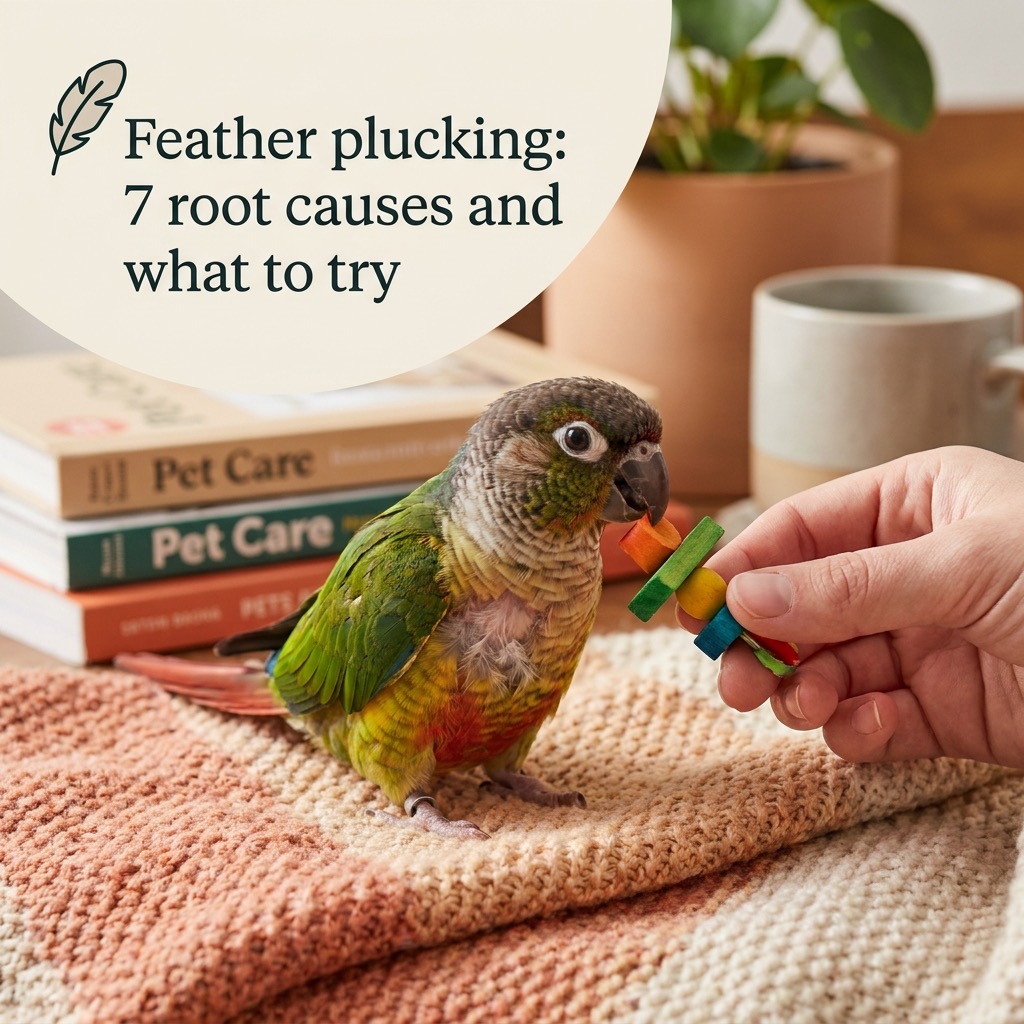
Feather plucking in parrots: 7 root causes and what to actually try
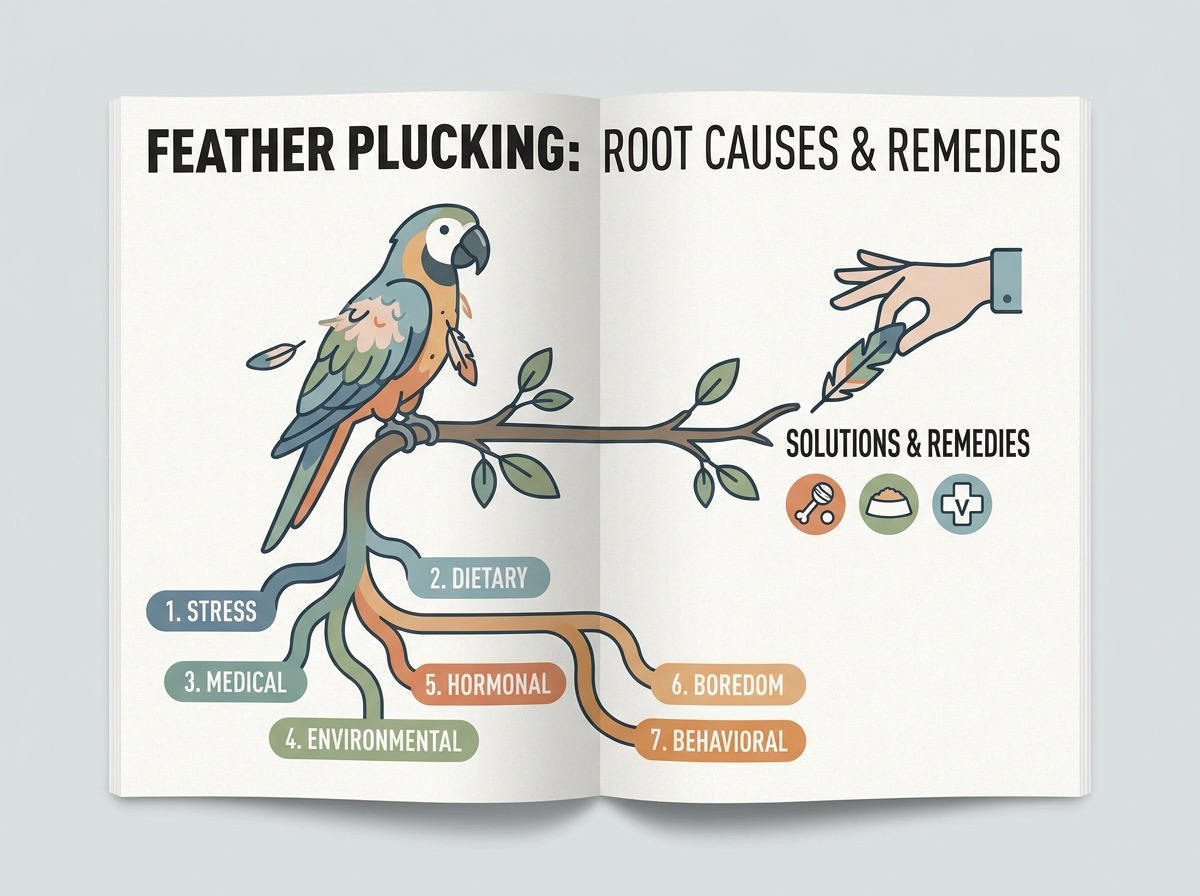
Feather destructive behaviour (FDB) is one of the most common and most misunderstood presentations I see in parrots. Owners arrive with a bird whose chest, flanks, or thighs are bare, sometimes bloody, often months into the problem, and ask for "something to stop it". The honest answer is that plucking is a symptom — the same symptom with seven different underlying causes, and the treatment for one can worsen another.
This is the order I screen.
1. Medical causes first — always
Before any behaviour work, rule out:
- Skin infections — bacterial (Staph, often secondary), fungal (Aspergillus, Candida)
- External parasites — mites (Knemidocoptes, Sternostoma), lice
- Internal disease — liver disease, kidney disease, hypothyroidism, heavy metal toxicity
- Pain — any source of chronic pain can present as plucking (especially over the keel or flanks)
This is not optional. A bird that is plucking because of zinc toxicity from a new cage will not improve with more toys. Bloodwork, faecal parasite screen, and a full physical exam by an avian vet come first.
2. Diet — the foundation most owners skip
The most common nutritional cause of plucking is all-seed diets. Seeds are high-fat, low in vitamin A, low in calcium, and deficient in omega-3. A bird on an all-seed diet is, by 18 months, often chronically deficient.
The fix is a measured conversion to pellets plus a wide variety of fresh foods:
- 60–70% high-quality pellets (Harrison's, Roudybush, TOPs, Lafeber)
- 20–30% fresh vegetables (cooked sweet potato, leafy greens, carrot, broccoli)
- 5–10% fruit (limited — high sugar)
- 5–10% seeds and nuts (treats, training rewards, foraging only)
Conversion takes 4–12 weeks. Don't rush it.
3. Humidity and bathing
Many plucking parrots — particularly African greys and cockatoos — are living in dry indoor air. Wild psittacines bathe daily and live at 60–80% humidity. Indoor humidity in winter is often 20–30%.
Practical fixes:
- Daily misting with plain warm water, or
- A shallow bath dish in the cage, refreshed daily, or
- A shower perch in the bathroom while you shower (humidity rises), or
- A humidifier in the room, aimed at 50–60% relative humidity
Within 2–3 weeks, many birds show better feather quality simply from hydration of the skin and preening glands.
4. Foraging and mental workload
In the wild, parrots spend 6–10 hours a day foraging. In captivity, food appears in a bowl. The behavioural vacuum is enormous.
Foraging enrichment that actually works:
| Type | Example | Time investment |
|---|---|---|
| Puzzle feeders | Acrylic foraging toys, wheel feeders | 15–30 min to set up |
| Wrapped food | Nuts in paper, pellets inside cardboard tubes | 5 min |
| Hidden food | Scatter in a tray of unscented paper pellets | 2 min |
| Chewable destructibles | Pine blocks, untreated wood, palm strips | Replace weekly |
| Training sessions | 5-min clicker sessions, 2–3 per day | 5 min each |
If your bird is not actively foraging for 30–60 minutes a day, you have not yet provided enough enrichment.
5. Sleep
Parrots need 10–12 hours of uninterrupted dark sleep per night. Less than this and chronic sleep deprivation develops, which presents as irritability, screaming, and yes, plucking.
Practical steps:
- A covered cage in a quiet, dark room
- A consistent bedtime (within 30 minutes)
- No late-night TV or noise
- If the household cannot provide this, a separate sleep cage in a quiet room
6. Social and pair-bonding issues
Plucking often appears in:
- newly single birds (lost a mate or owner moved away)
- birds in multi-bird homes where bullying is happening silently
- hand-reared birds with no clear social role
There is no single fix here. Work with an avian behaviour consultant. Often the answer is more interaction time, more training, and clearer routine.
7. Habit and learned behaviour
Once a bird has plucked for 6+ months, the behaviour can become habitual even after the underlying cause is fixed. This is the hardest case. Treatment combines:
- Continued environmental and dietary work
- Medical management of the itch-pain cycle (vet-prescribed)
- Behaviour modification with a clicker trainer
- In severe cases, a short course of prescribed medication to break the cycle
A diagnostic flowchart
Plucking observed
    ↓
Avian vet exam + bloodwork + faecal screen
    ↓
Medical cause found? → Treat
    ↓ No
Diet audit → Convert to pellets + fresh
    ↓
Humidity + bathing routine
    ↓
Foraging audit → Increase to 30–60 min/day
    ↓
Sleep audit → 10–12 hr dark, consistent
    ↓
Social/stress audit → Behaviour consultant
    ↓
Still plucking at 3 months?
    ↓
Habit + medical management, clicker training
What not to do
- Don't put a collar on without first ruling out medical causes. Collars cause severe psychological distress and don't address the underlying cause.
- Don't use over-the-counter "anti-plucking sprays" until you have a diagnosis. Many contain alcohol or bittering agents that worsen skin irritation.
- Don't increase one-on-one time alone in the short term if the underlying cause is medical — it can cement pain-as-social-contact associations.
When to see the vet immediately
- Blood feathers being pulled (can lead to serious bleeding)
- Open wounds, especially on the chest
- Sudden onset plucking (within days)
- Plucking in a bird under 1 year old (more likely medical)
Bottom line
Feather plucking is solvable in about 60–70% of cases I see — but only if the owner is willing to work through the seven-layer checklist in order. Skipping layers, or treating one cause while ignoring another, is the most common reason plucking becomes chronic. Patience, systematic work, and an avian vet as a partner are the three non-negotiables.
---
About the author: [Ravi Patel](../Ravi%20Patel.md) is an MSc in Exotic Animal Medicine from the Royal (Dick) School of Veterinary Studies, Edinburgh, with 18 years of practice. He is a founding member of the Wildlife and Exotic Animal Veterinary Association (India).